Florida Keys Wild Ecosystems and the Beauty of a Fragile Paradise

The Florida Keys feel like the edge of the map, but they are not empty or remote in the way open water can seem. Life gathers everywhere. It clings to mangrove roots, hides in seagrass meadows, drifts over coral reefs, and patrols the channels between the Atlantic Ocean, Florida Bay, and the Gulf of Mexico.
This island chain sits between powerful natural worlds. To the north and west lie the watery margins of the Everglades. To the south and east stretch warm Atlantic currents and the Florida Reef. Between them are flats, banks, cuts, islands, and deep blue water. The result is a rare meeting place for birds, fish, reptiles, corals, sharks, rays, turtles, and microscopic life that holds the whole system together.
The beauty is easy to see. The fragility takes longer to understand. The Keys are not just a vacation setting with pretty water. They are a living chain of connected habitats, and each one depends on the health of the others.
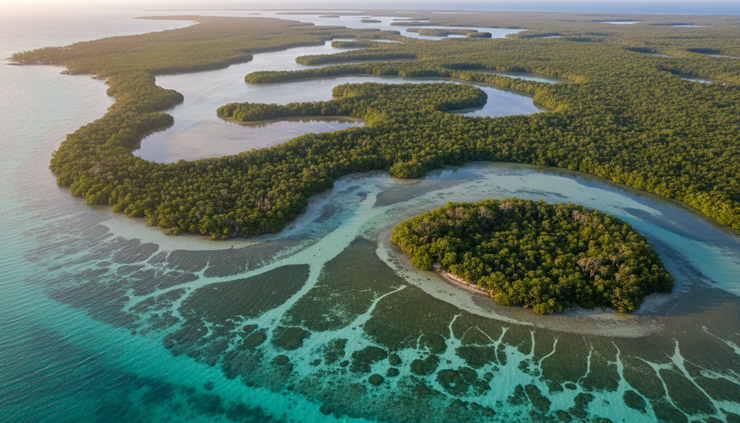
Where the Everglades meet the island chain
The Florida Keys do not stand apart from the Everglades. They belong to the same broad water story. Rain falls across South Florida, moves through marshes and sloughs, and eventually reaches Florida Bay and the surrounding coastal waters. That slow movement of freshwater helps shape the chemistry, clarity, and life of the region.
Florida Bay, north of the Keys, is a shallow sheet of water broken by mud banks, mangrove islands, and seagrass beds. It acts like a transition zone between the inland Everglades and the saltier waters beyond the island chain. Small changes in freshwater flow, salinity, temperature, or water clarity can affect large areas.
This is why the wild edges of the Everglades matter so much to the Keys. A bird feeding on a flat, a tarpon rolling in a channel, or a sponge growing in clear water may all depend on conditions shaped miles away.
The connection is not always visible from shore. It shows up in quieter ways:
Clear water allows seagrass and corals to receive sunlight.
Balanced salinity supports fish, invertebrates, and nesting birds.
Healthy mangrove shorelines reduce erosion and provide shelter.
Good water movement carries nutrients without letting pollution collect.
The Keys are often described as islands, but ecologically they are more like bridges. They link fresh, brackish, and saltwater habitats across a wide arc of South Florida.
Mangroves are the quiet engineers of the Keys
Mangroves may not look dramatic from a distance. They often form low, tangled walls along shorelines and island edges. Up close, they are among the most important habitats in the Florida Keys.
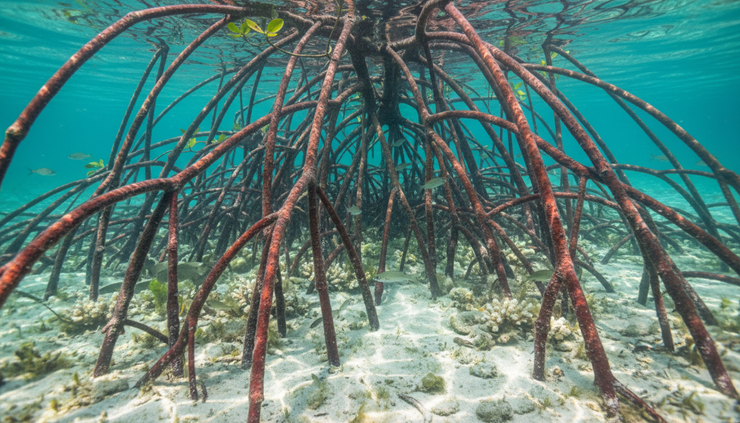
These salt-tolerant trees grow where many plants cannot survive. Their roots spread into shallow water, creating a maze of shelter. Juvenile fish use that maze to avoid predators. Crabs, shrimp, snails, and sponges live among the roots. Birds perch, nest, and hunt along their branches.
Mangroves protect life at several scales. For a young snapper, they are a nursery. For a shoreline, they are a living buffer. For the wider ecosystem, they help filter water and trap sediment before it reaches seagrass beds and coral reefs.
The main mangroves in the Keys include red, black, and white mangroves. Red mangroves are the easiest to recognize because of their prop roots, which arch into the water like stilts. Those roots slow waves and give small creatures places to hide.
Mangrove islands also create edges, and edges are rich with life. At low tide, wading birds stalk the shallows. At high tide, fish move into flooded roots to feed. In calm channels, it is common to see mullet flashing near the surface or needlefish hovering in the shade.
Mangroves do their work quietly, but without them the Keys would be more exposed, less productive, and far less wild.
Seagrass flats are the hidden meadow under the water
From a boat, a seagrass flat may look like a dark patch beneath pale water. From above, the pattern can resemble broad underwater fields. These flats are some of the most productive habitats in the Keys.
Seagrasses are flowering plants, not seaweed. They need sunlight, clean water, and stable bottom conditions. When healthy, they create food and shelter for many forms of marine life. Small fish, shrimp, conch, sea stars, sponges, urchins, and countless tiny organisms live in and around the blades.
Seagrass also supports larger animals. Green sea turtles graze on it. Bonefish, permit, and tarpon move across nearby flats and channels. Rays fan the bottom while feeding. Herons and egrets work the edges when the tide drops.
The value of seagrass is easy to miss because its best work happens under the surface. It holds sediment in place, which helps keep water clear. Clear water then supports more seagrass and better reef conditions. That cycle can build strength, but it can also break down if water grows murky or bottoms get scarred.
Boat propellers can cut trenches through shallow flats. These scars may take a long time to heal. In some places, they change water flow and allow bare sediment to spread. For a habitat made of living plants, a narrow scar can become a lasting wound.
That is why marked channels and careful boating matter in the Keys. Protecting seagrass protects more than grass. It protects nurseries, feeding grounds, water clarity, and the quiet base of the food web.
Coral reefs bring color, structure, and risk
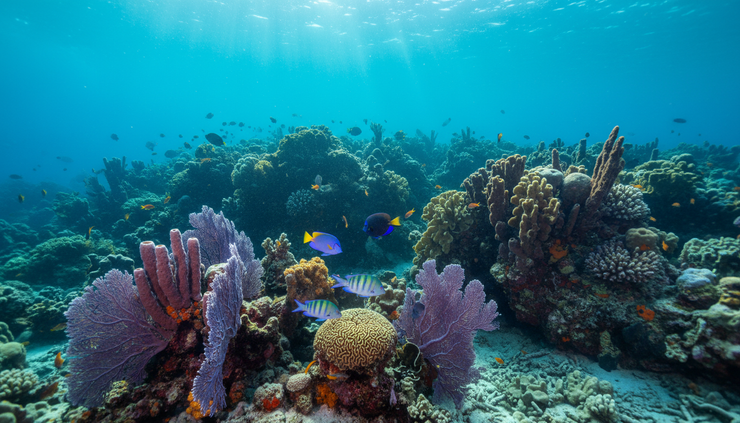
The Florida Keys are closely tied to the Florida Reef, a long coral reef system that runs near the island chain. Reefs are often celebrated for color, and for good reason. Coral heads, sea fans, sponges, parrotfish, angelfish, barracuda, and schools of small fish create scenes that feel almost unreal.
Yet coral reefs are not decorations. They are living structures built by tiny coral animals over long periods of time. These structures create shelter for fish and invertebrates. They also help break wave energy before it reaches shore.
A reef is both a neighborhood and a barrier. Fish feed, hide, clean, mate, and migrate through it. Lobsters squeeze into crevices. Moray eels wait in holes. Nurse sharks rest near the bottom. Sea fans bend with the current. Every surface has a role.
The reefs of the Keys face serious pressure. Warm water can stress corals and lead to bleaching. Disease can damage coral colonies. Poor water quality can make recovery harder. Physical contact from anchors, fins, or careless handling can break pieces that took years to grow.
Reef health also depends on animals that keep the system balanced. Parrotfish and other grazers help control algae. Predators influence fish behavior and population patterns. Sponges filter water. Even small creatures matter because reefs run on close relationships.
There is still beauty on the reefs, and there is still reason to care. Restoration work, marine protected areas, better boating habits, and careful snorkeling and diving can reduce harm. Reefs have limits, but they are not beyond help.
The open ocean keeps the wild close
Beyond the reefs, the water changes character. Shallow turquoise gives way to deeper blue. Currents strengthen. The animals grow larger and more wide-ranging.
The open ocean around the Keys brings sailfish, mahi-mahi, tuna, sharks, sea turtles, dolphins, and migrating birds. Some species pass through with seasons and currents. Others hunt around reef edges, wrecks, weed lines, or deep channels.
This offshore world connects the Keys to much larger ocean systems. A sea turtle nesting on a beach may travel great distances across the Atlantic or Gulf. A shark seen near a reef may range far beyond local waters. A seabird gliding low over the waves may have followed fish for miles.
The open ocean also feeds the imagination of the Keys. It gives the island chain its sense of space. Stand at the end of a pier at sunrise and the water seems endless. Watch frigatebirds circle high overhead and the wild feels close, even near a road, marina, or town.
That closeness is part of the Keys’ identity. Human life and wild life exist side by side here. A pelican may perch near a fish-cleaning station. A manatee may surface in a harbor. A nurse shark may cruise under a dock. The natural world is not locked behind a gate. It moves through the same channels, bridges, and shorelines people use every day.
A fragile paradise shaped by pressure
The phrase fragile paradise can sound poetic, but in the Keys it is practical. Low islands, shallow waters, and narrow habitats leave little room for stress.
Storms, heat, sea level rise, heavy boat traffic, coastal development, pollution, and wildlife disturbance all place pressure on the system. Some threats are global. Others are local and immediate. A careless anchor, a grounded boat, a plastic bag, or a touched coral can cause real damage in a place where recovery may be slow.
The fragility comes from connection. Damage in one habitat can move into another. Murky water can harm seagrass. Seagrass loss can affect fish nurseries. Reef decline can reduce shelter and shoreline protection. Mangrove removal can increase erosion and remove nesting and feeding areas.
Yet connection also creates hope. Protecting one part can support many others.
Simple choices help:
Use reef-safe boating practices and anchor only where allowed.
Stay in marked channels across shallow flats.
Keep distance from birds, turtles, dolphins, manatees, and nesting areas.
Never touch coral, chase wildlife, or stand on seagrass.
Pack out trash and reduce single-use plastics near the water.
Support parks, refuges, sanctuaries, and local conservation work.
These actions may sound small, but they match the scale of many daily impacts. In the Keys, care often begins with restraint.

The beauty is in the connections
The Florida Keys are beautiful because they are alive at every edge. Mangroves lean into saltwater. Seagrass bends with the tide. Coral reefs rise from clear shallows. Open ocean carries travelers from far beyond the horizon. Birds, fish, turtles, sharks, rays, sponges, and corals all take part in a system that is larger than any single island.
To see the Keys well is to look past the postcard view and notice the relationships. The mangrove root shelters the young fish. The seagrass steadies the water. The reef breaks the waves. The ocean brings movement and return. The Everglades send their slow influence south.
That is the real beauty of this fragile paradise. It is not only the color of the water or the shape of the islands. It is the fact that the wild is still present, still working, and still asking for room to survive.


Comments